1.Heat spreading
Conducts heat through an electrically insulating ceramic, helping manage local hot spots in compact assemblies.

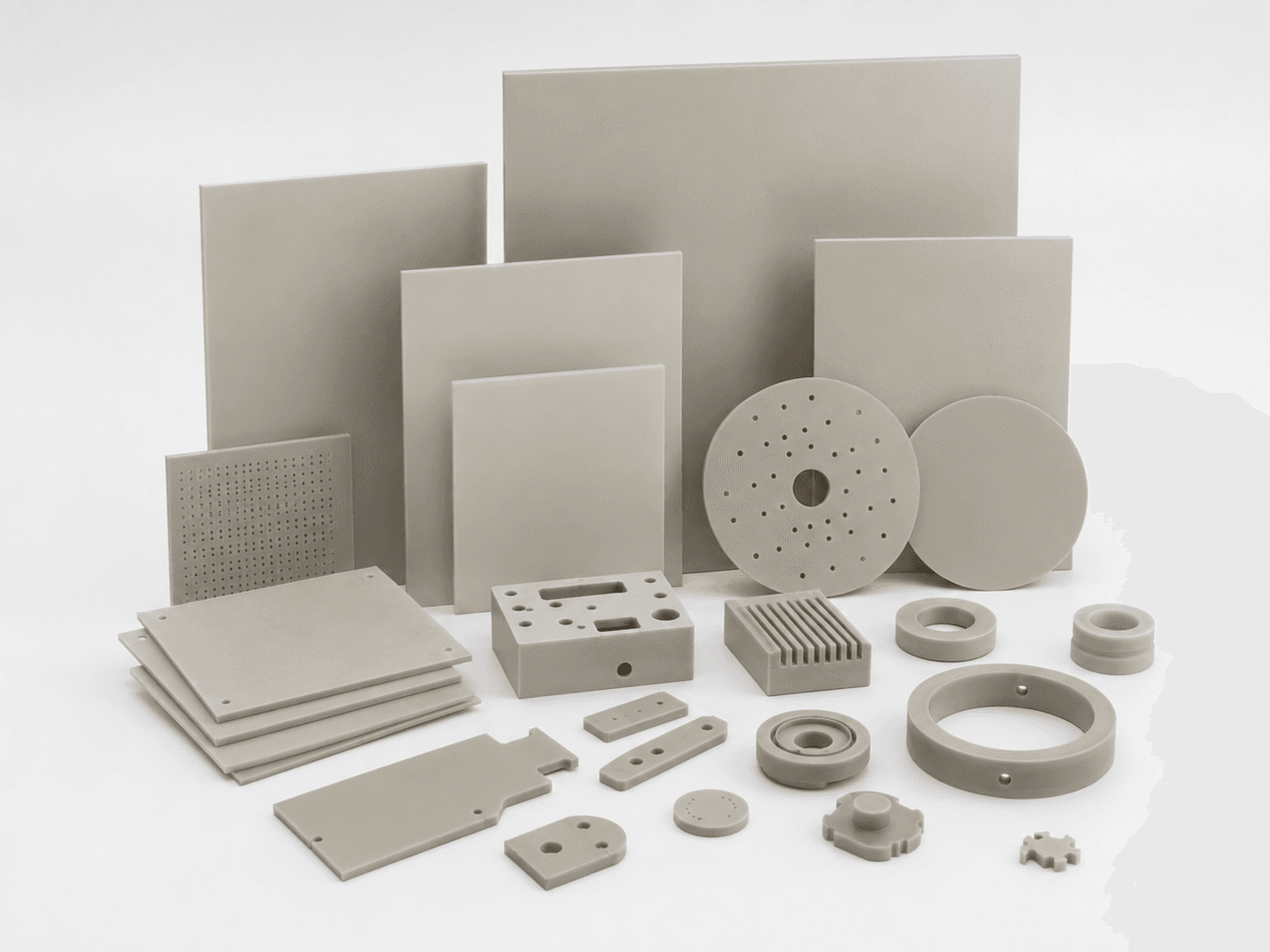
Aluminum nitride (AlN) combines efficient heat transfer with electrical insulation for power electronics, semiconductor equipment and precision thermal interfaces.
High thermal conductivity electronic ceramics
Conducts heat through an electrically insulating ceramic, helping manage local hot spots in compact assemblies.
Selected grades provide high resistivity for insulating supports and thermal interfaces; performance must be checked at operating temperature.
Expansion closer to silicon than many metals can help manage package stress when the complete joint is correctly designed.
Stiff substrates and structural parts combine mechanical support with a useful heat-transfer path.
Compatible metallization and bonding routes can connect the ceramic to electronic assemblies, subject to interface and process qualification.
Insulating substrates and heat-spreading interfaces help move heat away from power devices.
Submounts and carrier plates provide a thermally conductive base without making the ceramic electrically conductive.
Heater plates and insulating components support temperature distribution; purity, resistivity and process chemistry require grade-specific review.
Thermal spacers and engineered cooling components combine heat transfer with electrical separation.
Ceramic carriers can support device heat removal; dielectric performance must be verified at the intended frequency.
| Material / route | Density (g/cm³) | Bending strength (MPa) | Conductivity (W/(m·K)) | Material distinction |
|---|---|---|---|---|
| High-conductivity AlN | 3.30 g/cm³ | 300 MPa (4-point, 20°C) | 180 W/(m·K), 20°C | Reference grade for heat transfer with electrical insulation. |
| Hot-pressed AlN | 3.25 g/cm³ | 365 MPa (4-point, 20°C) | 80 W/(m·K), 20°C | Hot-pressed reference; not interchangeable with high-conductivity grades. |
| 96% alumina | 3.72 g/cm³ | 343 MPa (4-point, 20°C) | 24.7 W/(m·K), 20°C | Nominal 96% Al₂O₃; a general insulating-ceramic reference. |
| Dense structural Si₃N₄ | 3.21 g/cm³ | 1,000 MPa (4-point, 20°C) | 34 W/(m·K), 20°C | Structural silicon nitride emphasizes strength and toughness. |
Near-net shaping before firing can reduce hard machining; allow for sintering shrinkage in the design.
Densification route and additives influence thermal conductivity, electrical behavior and achievable geometry.
Final machining establishes critical dimensions and mating surfaces; coolant and cleaning chemistry require qualification.
Thin substrates may be laser processed and metallized; edge quality, layer adhesion and thermal cycling need validation.
Qualify aqueous cleaning, coolant exposure and process gases for the selected AlN grade. Dense AlN normally requires diamond finishing; machinable AlN/BN composites are different materials. No universal maximum service temperature or plasma-resistance claim applies.
Process availability and acceptance criteria are confirmed for the selected component.
Send the drawing, quantity, medium, temperature cycle, load and critical surfaces. Material route and process options are confirmed for the selected part.
Request a quote