1.Strength with toughness
Dense silicon nitride grades resist crack growth under demanding mechanical loads, while still requiring ceramic-aware design.

Silicon nitride (Si₃N₄) combines toughness, low mass and thermal-shock resistance for rolling contact, wear components and selected molten-aluminum handling applications.
Gas-pressure sintered and hot-pressed structural ceramics
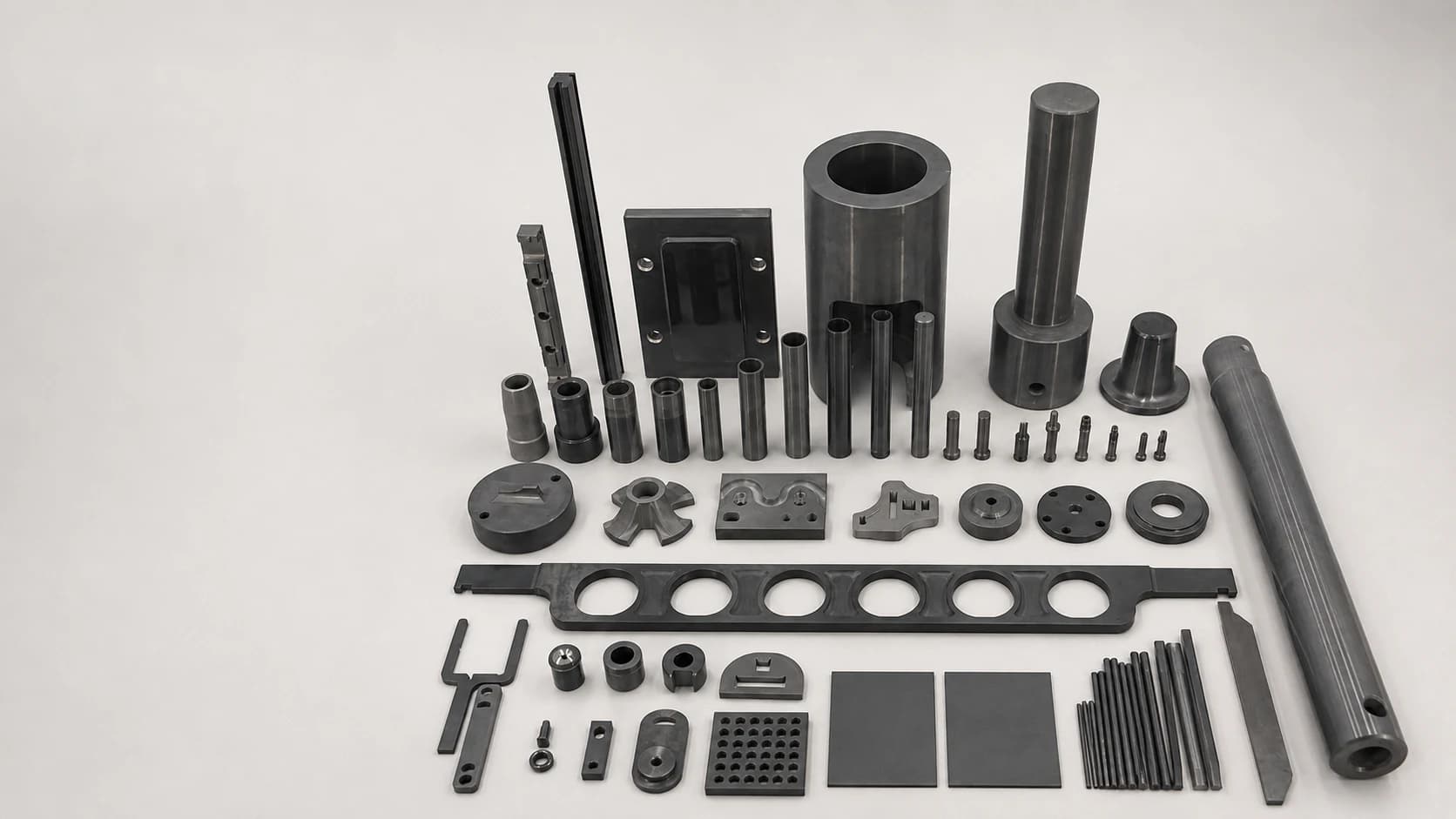
Dense silicon nitride grades resist crack growth under demanding mechanical loads, while still requiring ceramic-aware design.
Low expansion combined with strength and toughness helps components tolerate rapid temperature changes.
A low-density ceramic structure is useful where rotating mass or moving-part weight matters.
Hard, precision-finished surfaces suit rolling and sliding contact when lubrication, finish and mating materials are matched.
Selected grades are used in molten-aluminum handling; alloy composition, fluxes and operating conditions require compatibility checks.
Insulating grades support bearing and tooling designs where unwanted current paths are a concern.
Balls and rollers combine low mass, wear resistance and stiffness for demanding rolling-contact systems.
Riser tubes and immersion components exploit thermal-shock resistance and low wetting in qualified aluminum-melt processes.
Location pins and rollers provide wear-resistant, electrically insulating contact points during repeated heating cycles.
Wear components can combine mechanical durability with chemical resistance after fluid and load compatibility are established.
High-temperature fixtures and structural parts benefit from low expansion and thermal-shock resistance; atmosphere and loading set the service envelope.
| Material / route | Density (g/cm³) | Bending strength (MPa) | Conductivity (W/(m·K)) | Material distinction |
|---|---|---|---|---|
| Dense structural Si₃N₄ | 3.21 g/cm³ | 1,000 MPa (4-point, 20°C) | 34 W/(m·K), 20°C | Dense structural grade; published fracture toughness 6.5 MPa·√m. |
| Direct-sintered SiC | 3.15 g/cm³ | 480 MPa (4-point, 20°C) | 150 W/(m·K), 20°C | Direct-sintered SiC reference; prioritizes hardness and heat transfer, not the same toughness profile. |
| High-conductivity AlN | 3.30 g/cm³ | 300 MPa (4-point, 20°C) | 180 W/(m·K), 20°C | Thermal-management reference with electrical insulation, not a direct structural substitute. |
A dense structural route for shaped components; grade selection balances strength, toughness and thermal behavior.
Pressure-assisted routes reduce porosity; choose the route around component geometry and required performance.
Low dimensional change supports near-net shapes, but residual porosity changes strength and suitability for sealed service.
Post-sinter grinding and lapping establish dimensions and surface quality for bearing, sealing and locating features.
Match the grade to temperature, atmosphere, cyclic loading and chemical exposure. Molten-aluminum compatibility is not resistance to every metal or flux. Reaction-bonded and dense sintered materials are not interchangeable.
Process availability and acceptance criteria are confirmed for the selected component.
Send the drawing, quantity, medium, temperature cycle, load and critical surfaces. Material route and process options are confirmed for the selected part.
Request a quote