
Browse Materials
Back to materialsSiC
Silicon Carbide
A high-hardness ceramic for severe wear, high temperature, thermal shock and chemically aggressive environments.
SSiC, RBSiC, RSIC and SiC-based ceramics
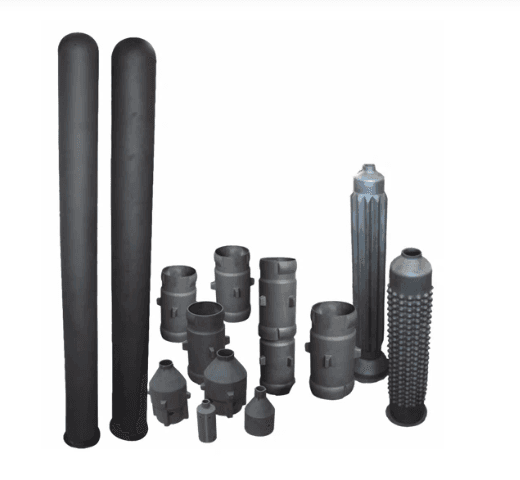
Technical specifications
Typical reference data for first-round screening.
Values are typical engineering references. Final material selection should confirm grade, process route, geometry, tolerance and test method.
| Density | 3.10 g/cm³ typical |
|---|---|
| Hardness | ≈20.6 GPa (converted from HV1 2100) |
| Max service temperature | 1,600 °C in air, no-load screening reference |
| Thermal conductivity | 100 W/(m·K) at room temperature |
| Flexural strength | 400 MPa typical at room temperature |
| Fracture toughness | 4.0 MPa·m¹/² typical |
| Electrical behavior | Usually semiconductive; resistivity depends on grade |
Typical applications
- Mechanical seal rings, pump sleeves and bearing components
- Kiln furniture, beams, rollers and radiant tubes
- Nozzles, liners and wear parts for abrasive fluids
- Semiconductor process carriers and thermal processing fixtures
Advantages
- Excellent hardness and wear resistance
- High thermal conductivity compared with many oxide ceramics
- Strong corrosion resistance in many aggressive media
- Good dimensional stability in high-temperature service
Comparison notes
- Choose SiC over alumina when high heat flow, corrosion and severe wear occur together.
- Choose SSiC when density, corrosion resistance and tight performance are critical; RBSiC can be attractive for large kiln and structural parts.
Application review
Not sure if SiC is the right material?
Send the working temperature, medium, wear mode, load, drawing, current failure problem and quantity. We can compare Silicon Carbide against other ceramic options.
Ask for recommendation