1.Machinable shapes
Holes, steps and other detailed features can be machined from consolidated hBN blanks.

Machinable hexagonal boron nitride (hBN) for electrical insulation, furnace fixtures and selected molten-metal contact parts. Binder system, pressing direction and atmosphere determine the grade choice; this is not cubic BN abrasive material.
Hexagonal boron nitride and machinable BN composites
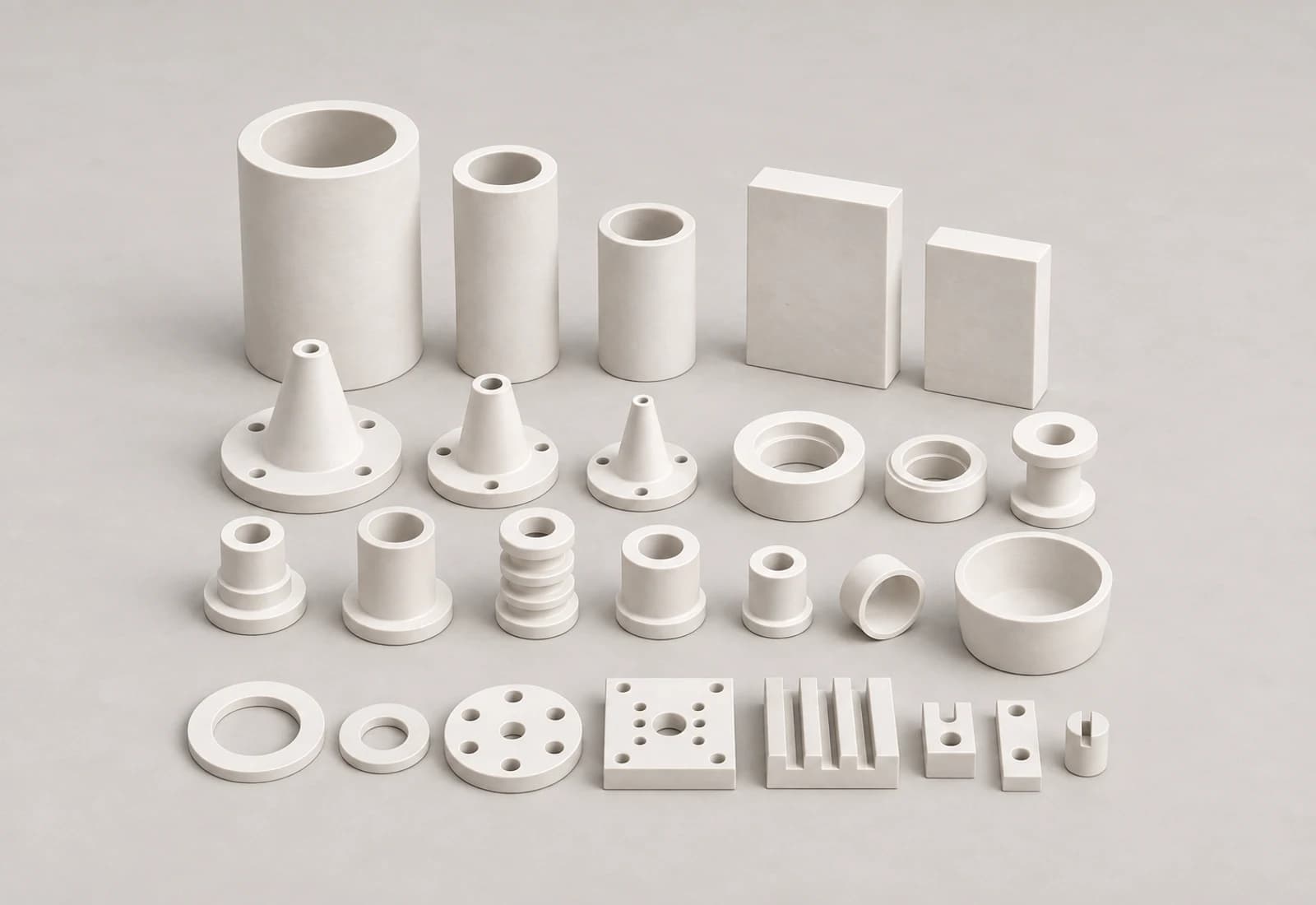
Holes, steps and other detailed features can be machined from consolidated hBN blanks.
Insulating grades suit spacers, sleeves and supports where electrical isolation is required.
Low expansion supports thermally cycled fixtures; geometry and heating rate still matter.
Selected grades resist wetting by many melts. Alloy, flux and atmosphere compatibility must be confirmed.
Low-density hBN grades reduce fixture mass; higher-strength composites trade purity for durability.
Insulating rings, sleeves and supports separate electrical conductors in controlled-atmosphere equipment.
Crucibles, nozzles and contact inserts use grade-specific wetting resistance; pure hBN and reinforced grades are not interchangeable.
Machined spacers and plates combine electrical isolation with application-specific thermal behavior.
High-purity containers require a specified composition and contamination budget. CVD pyrolytic BN is a separate material route, not a substitute name for hot-pressed hBN.
| Material / route | Density (g/cm³) | Bending strength (MPa) | Conductivity (W/(m·K)) | Material distinction |
|---|---|---|---|---|
| Self-bonded hBN | 1.9 g/cm³ | 21–22 MPa (25°C; two directions) | 78–130 W/(m·K) (25°C; two directions) | High hBN content; lower bending strength. |
| Borate-bonded hBN | 2.0 g/cm³ | 45–59 MPa (25°C; two directions) | 27–29 W/(m·K) (25°C; two directions) | Calcium-borate binder; moisture response differs from self-bonded hBN. |
| hBN–silica composite (60/40) | 2.1 g/cm³ | 34–62 MPa (25°C; two directions) | 11–29 W/(m·K) (25°C; two directions) | 60% hBN / 40% silica; a composite, not pure BN. |
Pressing aligns hBN platelets. Specify the part orientation when thermal or mechanical behavior is critical.
Self-bonded, borate-bonded and reinforced formulations differ in strength, moisture response and service atmosphere.
Plan holes, thin walls and edge details around the selected grade. Dry machining and dry storage avoid unwanted contamination or moisture uptake.
Pyrolytic BN is deposited by CVD. Purity, leak-tightness and process compatibility require a separate specification and supply confirmation.
Process availability and acceptance criteria are confirmed for the selected component.
Send the drawing, quantity, medium, temperature cycle, load and critical surfaces. Material route and process options are confirmed for the selected part.
Request a quote