
FreeWill Material Technical Ceramics

Electronics & Power-Module Substrate Family

Silicon Nitride Ceramic Substrates

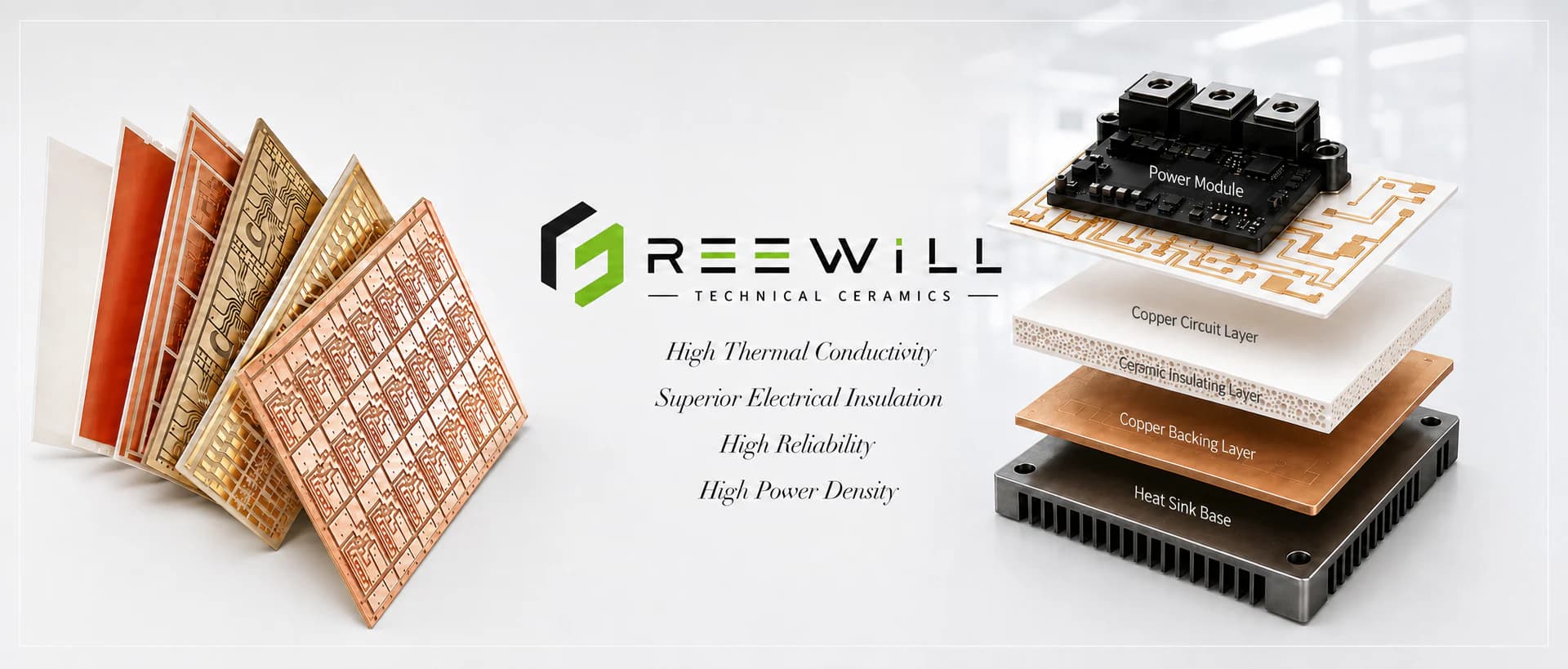
FreeWill Material ceramic substrates and power module thermal-management assembly

High-strength Si3N4 substrates for power-electronic assemblies where fracture toughness, thermal shock and repeated thermal cycling drive reliability.

Material & Process Filter

Filter compatible substrate processes.

Only technically compatible routes are shown. Select one or more processes to compare matching products; clear the selection to return to the base-material portfolio.

Compatible process routes

Product Family Portfolio

Silicon Nitride Ceramic Substrate Products

Select a product route for detailed application and drawing-review guidance.

1 products

Silicon Nitride Ceramic Substrate Sheets product overview

Silicon Nitride Ceramic Substrate Products

Silicon Nitride Ceramic Substrate Sheets

High-strength Si3N4 substrate sheets for reliability-focused power electronics and severe thermal-cycling applications.

Typical application directions

SiC Power Modules · Automotive Inverters

View Product Details

Product Options

Bare and AMB-oriented Si3N4 substrate formats.

The selected power-substrate grade and thickness are reviewed against thermal resistance and module reliability.

Customer-controlled integration

Bare Si3N4 Substrates

High-reliability insulating substrates for custom processing or metallization.

  • High strength
  • Thermal-shock resistance

Power-module platform

AMB-Ready Si3N4 Substrates

Thin, tough ceramic substrates prepared for thick-copper active metal brazing.

  • Thermal-cycle reliability
  • Automotive power modules

Processing Capabilities

Processing reviewed for thin, high-reliability substrates.

Laser features and metallization depend on grade, thickness, edge quality and module layout.

  • Custom Outlines
  • Laser Processing
  • Hole / Slot Features
  • Surface Preparation
  • AMB Metallization
  • Patterned Copper
  • Custom Geometry

Typical Properties

Reliability-focused Si3N4 power-substrate properties.

Values refer to selected power-substrate grades and remain grade or method dependent where stated.

PropertyWebsite referenceCondition
Density3.2–3.3 g/cm³ typicalGrade dependent
Flexural strength650–800+ MPaGrade and test-method dependent
Fracture toughness≥6 MPa·m½Selected power-substrate grades
Thermal conductivity80–90 W/m·K typicalPower-substrate grades
CTE2.6–3.2 × 10⁻⁶/K typicalTemperature-range dependent
Dielectric strength≥15 kV/mm referenceThickness and method dependent
Volume resistivity≥10¹⁴ Ω·cm typicalAt room temperature

Available Specifications

Thin substrate formats for power-module integration.

Dimensions, warpage and features are reviewed together with any copper layout.

ItemWebsite referenceCondition
Standard thickness0.25 and 0.32 mm for AMB power substratesOther thicknesses available by request
Sheet references110 × 110, 114.3 × 114.3 and approximately 138 × 190.5 mmSubject to grade and drawing review
Dimensional tolerance±0.2 mm referenceTighter values by review
Flatness / warpageControlled to drawingDepends on size, thickness and copper layout
SurfaceAs-fired or prepared for AMBApplication dependent
Laser processingAvailableSubject to thickness, edge quality and drawing review

Applications

Reliability for severe power-module duty.

Si3N4 is selected when mechanical loading and thermal cycling matter more than maximum bulk thermal conductivity.

  • EV Power Modules
  • Automotive Inverters
  • Traction Inverters
  • IGBT Modules
  • SiC Power Modules
  • Industrial Power Modules
  • Renewable Energy Converters
  • Rail Traction
  • High Thermal-Cycling Environments

Selection Guidance

Choose Si3N4 for toughness and cycle life.

The design decision balances heat flow with mechanical and thermomechanical reliability.

PriorityRecommended directionSelection reason
Maximum bulk thermal conductivityAluminum NitrideHigher conductivity class
Cost-effective general substrateAluminaMature and widely processed
High toughness and thermal cyclingSilicon NitrideStrong power-module reliability position

Custom Manufacturing

Review ceramic and copper as one reliability system.

Bare and AMB requirements are evaluated with the module drawing.

  • Custom ceramic outlines
  • Laser features by review
  • 0.25 / 0.32 mm AMB references
  • Patterned thick copper
  • Selected plated finishes
  • Reliability and inspection requirements

Quality & Inspection

Control the features linked to module life.

Documentation and test scope are available on request and agreed before production.

  • Material grade review
  • Dimensions and thickness
  • Flatness / warpage
  • Surface and edge inspection
  • Copper thickness and pattern inspection
  • Braze integrity and agreed reliability tests

Packaging & Shipping

Rigid separation for thin ceramic and finished copper.

Packaging protects ceramic edges and the selected copper finish.

  • Individual part or master-card separation
  • Rigid trays
  • Surface-protection layers
  • Corrosion protection for copper where appropriate
  • Inner box and export carton
  • Wooden case when required

Ordering Information

MOQ and typical lead time.

Typical lead times depend on selected grade, layout, copper configuration, quantity and qualification requirements.

Recommended MOQ

5 pieces

Bare substrates

4–7 weeks

AMB configurations

6–10 weeks

FAQ

Questions buyers commonly ask.

Practical sourcing questions for material selection, processing and ordering.

Why choose Si3N4 when AlN has higher thermal conductivity?

Si3N4 combines useful heat transfer with substantially higher strength and fracture toughness, helping power modules withstand copper stress and repeated thermal cycling.

Is this the same product as a thermocouple protection tube?

No. This page covers flat electronic and power-module substrates, not molten-metal thermocouple protection tubes.

Is AMB the primary metallization route?

AMB is the priority route for high-reliability Si3N4 power modules, subject to ceramic, copper and layout review.

What is the MOQ and lead time?

Recommended MOQ is 5 pieces. Bare substrates are typically 4–7 weeks and AMB configurations 6–10 weeks, depending on design and quantity.

Material reference

Review material behavior separately from this electronics and power-module substrate offer.

Silicon Nitride Material Properties

What to Specify for RFQ

Describe the mechanical and thermal reliability duty.

Separate bare-substrate requirements from AMB circuit requirements.

  • Si3N4 grade
  • Bare or AMB format
  • Ceramic thickness
  • Copper thickness when applicable
  • Outline and circuit drawing
  • Flatness / warpage
  • Surface finish
  • Thermal-cycle requirement
  • Quantity and inspection plan

Engineering RFQ

Tell us what the substrate must do.

Provide the drawing, dimensions, quantity and application requirements so the team can review material and processing options before quotation.

Engineering RFQ

Tell us what the component must do.

All fields are required. Provide practical operating details so our team can review the material and manufacturing requirements.

Your request will be reviewed by our team before a technical or commercial response is issued.