
Silicon Carbide Crucibles
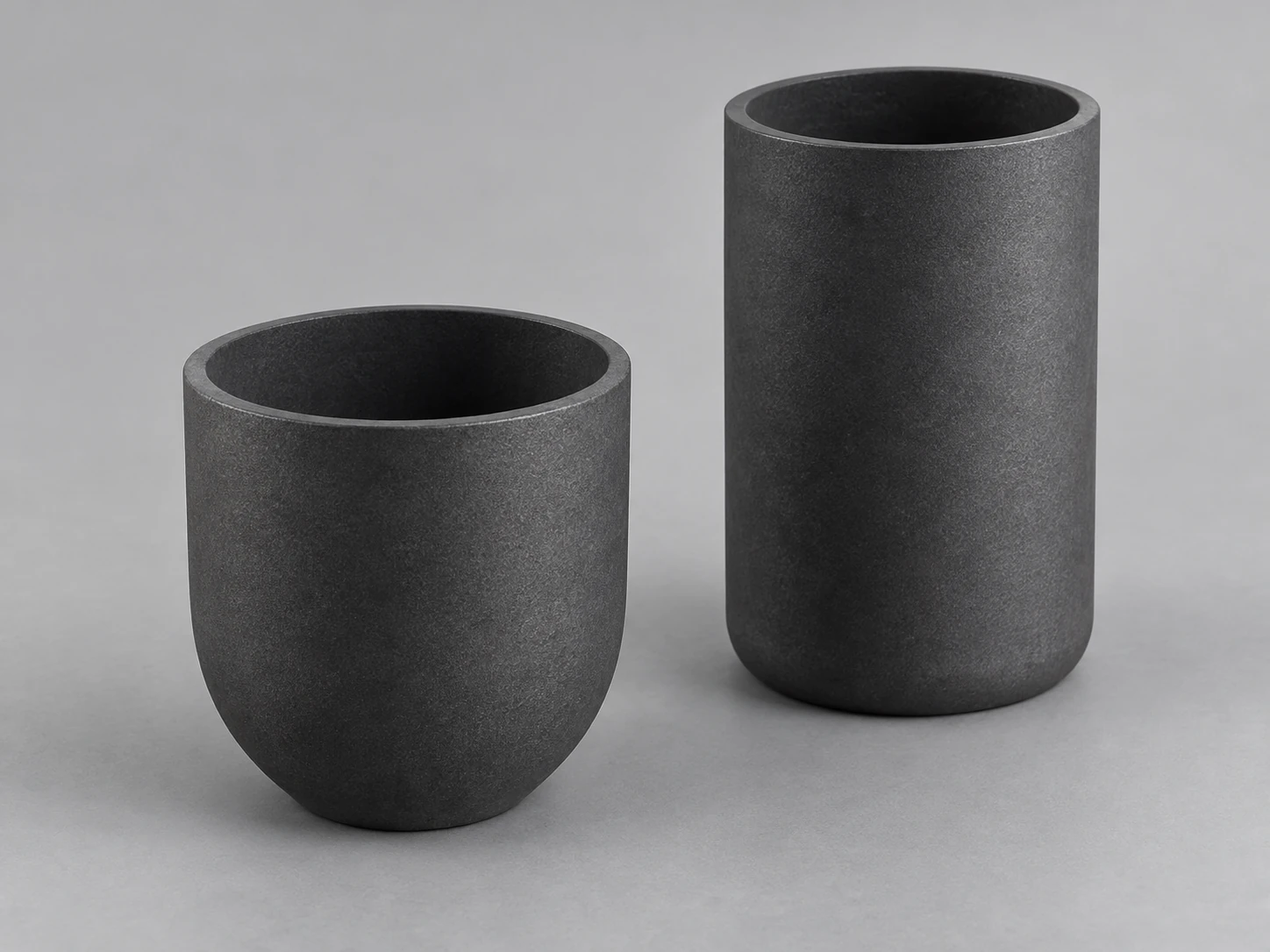
SiC-Containing Crucible
- Material
- SiC-containing crucible construction
- Size
- Drawing-defined dimensions
- Quantity
- Specify trial and production quantities
- Applications
- Non-ferrous metal melting and holding
We produce silicon carbide–graphite crucibles for non-ferrous metal melting and holding, with standard and custom forms matched to the alloy, working capacity and furnace.
Browse Products
Alumina Ceramic Products
Zirconia Ceramic Products
Silicon Carbide Products
Silicon Nitride Products
Aluminum Nitride Products
Product Description
We produce silicon carbide–graphite crucibles for non-ferrous metal melting and holding, with standard and custom forms matched to the alloy, working capacity and furnace.
We produce silicon carbide–graphite crucibles for melting and holding aluminium, copper alloys and zinc alloys. Heat passes through the crucible wall to the charge, while the vessel contains the molten metal for treatment and casting. We match the crucible construction to the alloy, furnace heating method and operating cycle.
Our range includes standard curved-wall, tapered, tall cylindrical and spouted forms. Custom height, rim, pouring spout, openings and base profiles can be made to suit the installation and handling arrangement. For replacement work, we compare the existing model, dimensions and working capacity with the required furnace fit.
Silicon carbide, graphite and a bonding phase combine heat transfer with resistance to thermal cycling and melt erosion. Carbon-bonded and ceramic-bonded constructions serve different duties; the body, protective glaze and furnace interface are selected together for the metal and operating conditions.
Product Features
- Heat transfer for melting and holding: The SiC–graphite body conducts heat through the wall to melt the charge and maintain molten metal during holding, supporting both batch melting and casting supply.
- Thermal-cycle resistance: A bonded structure accommodates thermal stresses during repeated heat-up, holding and cooling cycles; wall thickness and vessel form are matched to the cycle.
- Melt and flux resistance: The body and protective surface are selected for the alloy and treatment flux, helping limit erosion at the wall, base and working metal line.
- Oxidation protection: A protective glaze limits air attack on the carbon-containing body during heating and holding. The coating and preheating procedure work together to protect the vessel.
- Fit for the furnace and handling system: Curved-wall, tall and spouted forms adapt the working volume and pouring arrangement to lift-out, bale-out or tilting operation; base and rim geometry suit the support and handling tools.
Typical Applications
- Aluminium foundries: melting ingot or clean return metal and holding alloy before casting
- Brass, bronze and copper-alloy foundries: melting and holding in compatible fuel-fired or induction furnaces
- Zinc-alloy processing: melting and holding with a formulation selected for the alloy and furnace
Crucible Material Reference & Product Specifications
Reference Material Properties — Carbon-bonded SiC–Graphite
Published material-selection reference for one commercial series; not specifications for supplied products.
| Property | Reference value | Unit | Condition |
|---|---|---|---|
| Bulk specific gravity | 1.80–2.10 | Dimensionless | — |
| Apparent porosity | 18–24 | % | — |
| Modulus of rupture — room temperature | 6.9–17.7 | MPa | Room temperature |
| Modulus of rupture — hot | 4.9–13.2 | MPa | 1200°C |
| Linear expansion | 0.25–0.35 | % | At 800°C |
| Thermal conductivity | ≈23–61 | W/(m·K) | — |
Foundry Crucible Material Routes
| Construction | Typical role | Material characteristics | Applicable construction |
|---|---|---|---|
| Carbon-bonded SiC / graphite | Non-ferrous melting and holding | Heat-conducting SiC/graphite body with oxidation-protective glaze | Alloy, flux and furnace-specific formulation |
| SiC-containing clay-graphite | Selected melting and holding duties | Graphite and SiC in a ceramic-bonded structure | Ceramic-bonded construction |
| Dense engineering SiC | Separate engineered vessels/components | Sintered or reaction-bonded ceramic structure | Dense ceramic vessels / components |
Product Geometry & Configuration
| Product parameter | Configuration | Selection basis |
|---|---|---|
| Vessel form | Curved-wall, tapered, tall cylindrical or spouted | Lift-out, bale-out or tilting operation |
| Top outside diameter (mm) | Outside diameter at the top rim | Controls furnace opening and handling-tool clearance |
| Base outside diameter (mm) | Outside diameter of the supporting base | Matches the support block and seating surface |
| Overall height (mm) | Distance from the base to the highest rim | Defines the vertical installation envelope |
| Brimful volume (L) | Internal volume filled to the rim | Geometric capacity, separate from the working fill volume |
| Working volume (L) | Usable volume at the operating metal level | Leaves headroom for charging, treatment and pouring |
| Working charge (kg) | Metal mass = molten-alloy density × working volume | Use kg/L and L; mass capacity is alloy-specific |
| Wall and base | Construction-specific wall/base thickness | Heat transfer, erosion allowance and mechanical support |
| Heating system | Fuel-fired, electric resistance or induction-compatible construction | Induction coupling depends on crucible electrical characteristics and furnace frequency |
Charge Capacity and Furnace Fit
A replacement crucible is matched by its dimensions, working charge and furnace fit—not by model number alone. Standard sizes and custom forms use the same dimensional and capacity definitions.
Support, Charge and Heating: Selection Principles
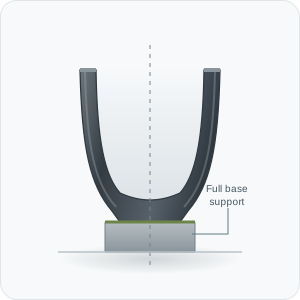
Level, centered support
Match the base and vessel bottom so the crucible is evenly supported. Include the support drawing and furnace installation envelope in the enquiry.

Room for charge expansion
Avoid tightly wedging solid charge against the wall. State the alloy, charge form, working quantity and handling method.
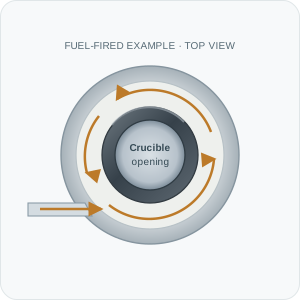
Match the heating system
Fuel-fired example: review burner placement to avoid direct flame impact. Resistance and induction systems need their own compatibility review.
| Parameter | Meaning | Specification guidance |
|---|---|---|
| Volume versus mass | Charge mass m = density ρ × usable volume V | For molten metal, use alloy density in kg/L at the operating temperature and working volume in L. Loose solid charge also depends on packing. |
| Furnace fit | Maximum outside diameter, overall height and base diameter | Include the furnace opening, support block and operating clearances. |
| Usable fill level | Working metal level below the rim | Allows for charging, treatment and handling; do not infer it from brim volume. |
| Construction | Bond system, graphite content, protective surface and grade reference | Construction is distinct from dense precision-SiC material grades. |
| Heating interface | Fuel-fired, resistance or specified induction furnace | For induction, include furnace power/frequency and the existing crucible reference. |
The support block, clearances, preheating, charging and lifting method form part of the furnace-fit review.
Available Forms
We produce standard and custom crucible forms for the working charge, furnace space and handling method.
- Standard curved-wall, tapered and tall cylindrical forms
- Spouted forms for the pouring arrangement
- Custom height, rim, openings and base profiles
- Replacement models matched by dimensions and furnace fit
Packaging & Shipping
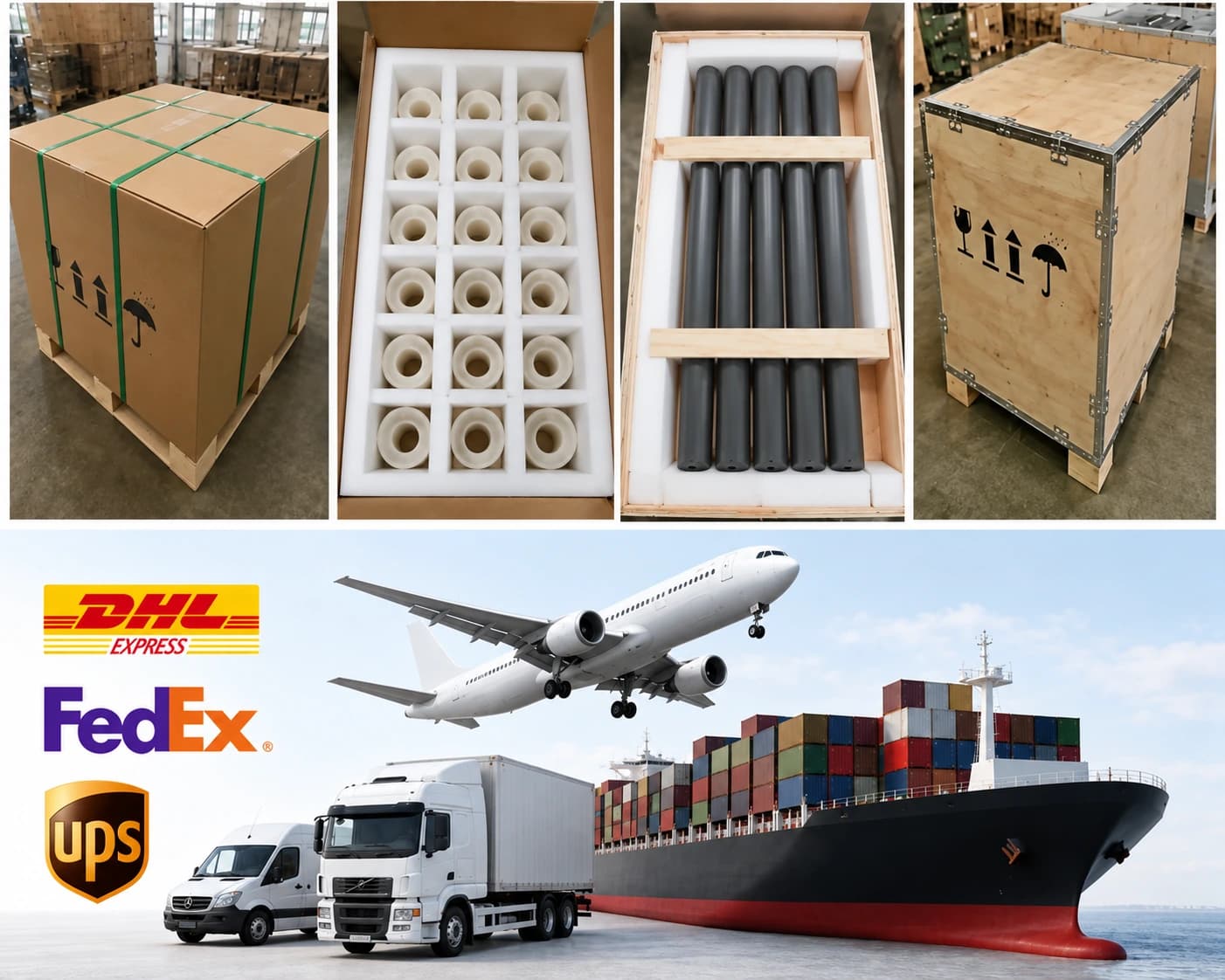
Packaging and transport are specified around component geometry, quantity and delivery requirements.
| Item | Details |
|---|---|
| Protection | Identify fragile edges, functional surfaces and individual separation requirements. |
| Packing scope | Confirm protective materials, carton or case arrangement and handling instructions with the order. |
| Shipping requirements | Provide destination, requested transport method and delivery requirements. |
| Payment terms | T/T / Western Union / PayPal; 50% advance payment, 50% balance before shipment |
| Shipping methods | Sea freight / Air freight / Door-to-door courier |
Related Ceramic Products
Explore distinct product requirements and material selections.
Frequently Asked Questions
What do you need for an initial quotation?
Tell us the alloy, working capacity and furnace type. An existing crucible model, photo or sketch is enough to start; a formal drawing is optional. We then review the construction, dimensions and furnace fit for the quotation.
Can you make a replacement or a custom shape?
Yes. We produce standard curved-wall, tapered, tall cylindrical and spouted forms, with custom height, rim, openings and base details. For a replacement, we check top and base outside diameters, overall height, support and handling interfaces against the original vessel.
Does the model number state the capacity in kilograms?
A model number identifies a size or pattern, not a universal kilogram capacity. Brimful volume is the volume to the rim; working volume leaves headroom. Metal charge in kilograms depends on the alloy density and working fill level.
Which temperature and furnace details matter?
Use the normal and maximum metal temperature, together with melting or holding time. Furnace setpoint and metal temperature are different. For induction furnaces, include frequency and power so the crucible's electrical characteristics can be matched to the heating system.
Is this the same material as a dense silicon carbide seal ring?
These foundry crucibles use a bonded SiC–graphite body. Dense sintered or reaction-bonded SiC is a different material route with different properties and applications.