
Alumina Ceramic Plates
Structural Ceramic Plate or Disc
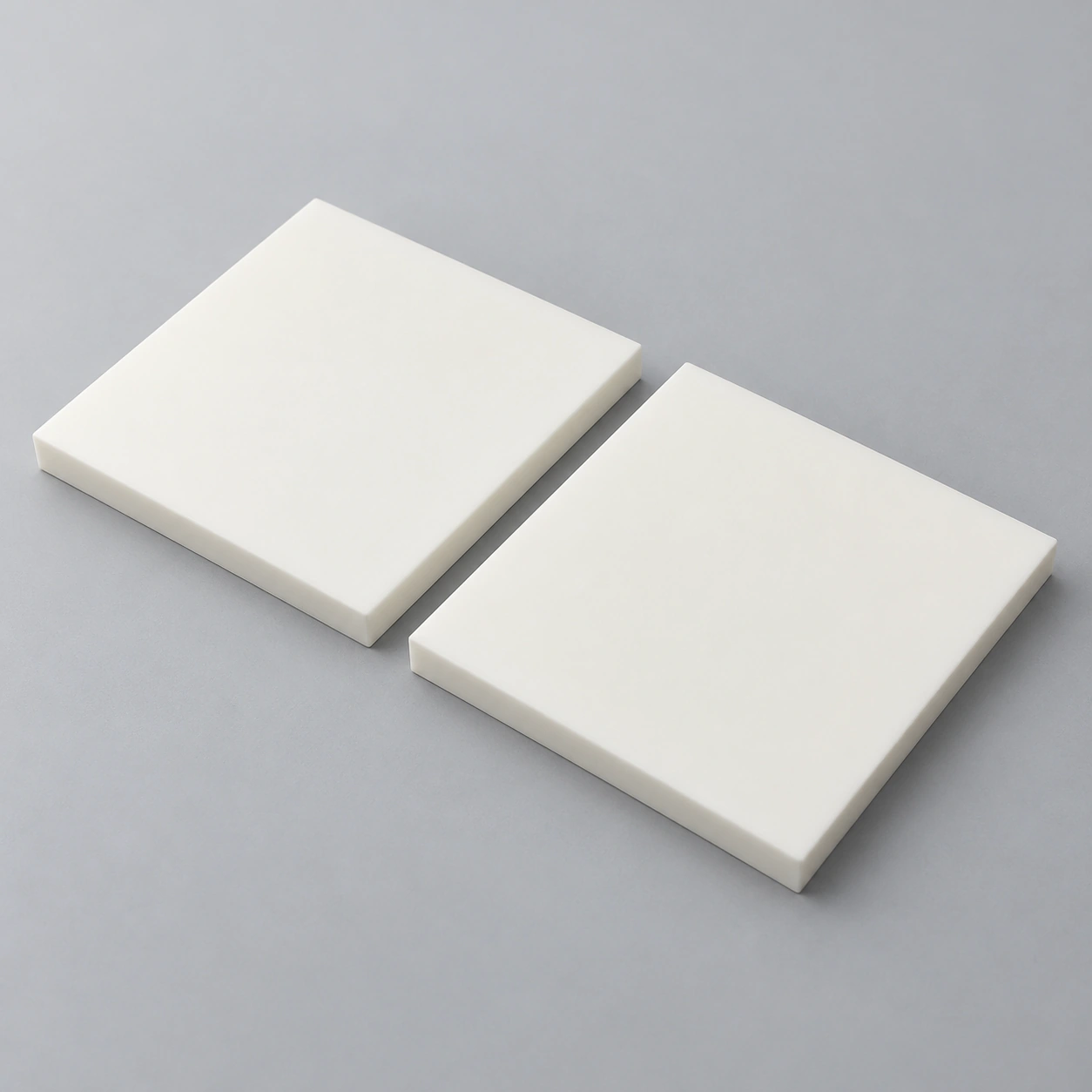
- Material
- Alumina
- Size
- Drawing-defined dimensions
- Quantity
- Specify trial and production quantities
- Applications
- Electrical insulation and wear components
Alumina ceramic plates and discs provide electrically insulating supports and hard wear-contact surfaces for industrial equipment, laboratory fixtures and thermal processing.
Browse Products
Alumina Ceramic Products
Zirconia Ceramic Products
Silicon Carbide Products
Silicon Nitride Products
Aluminum Nitride Products
Product Description
Alumina ceramic plates and discs provide electrically insulating supports and hard wear-contact surfaces for industrial equipment, laboratory fixtures and thermal processing.
Alumina plates and discs are flat structural components that support parts, separate electrical potentials or provide a hard working surface. Rectangular plates, circular discs and annular spacers place the ceramic where the assembly needs insulation, wear resistance or stable geometry.
Alumina combines electrical insulation with hardness and resistance to many chemicals. Ground or polished functional faces can be specified where contact, flatness or parallelism controls the assembly.
These are structural and functional components rather than thin electronic circuit substrates. Grade, thickness and mounting are chosen for the load, temperature and process medium; a ceramic disc becomes a valve or sealing part only with the required mating geometry and validation.
Product Features
- Electrical isolation: Alumina separates conducting parts while providing a rigid support. Insulation performance depends on temperature, thickness and surface condition.
- Hard wear-contact surfaces: The ceramic surface resists abrasion in guides, spacers and contact components, helping maintain working geometry.
- Stable flat geometry: Rigid plates and precision-finished faces provide repeatable support and locating surfaces for mechanical assemblies.
- Chemical and thermal stability: Oxidation resistance and chemical stability make alumina useful in laboratory and process equipment with a compatible medium and thermal cycle.
- Adaptable part features: Rectangular, circular and annular forms can incorporate drawing-defined holes, recesses and edges to match the installation.
Typical Applications
- Industrial electrical equipment: insulating plates and spacers between live parts and supports
- Process machinery: wear-contact plates, guide surfaces and precision discs
- Laboratory and furnace equipment: flat supports and setters for compatible materials under controlled thermal cycles
- Mechanical assemblies: dimensionally stable ceramic shims, locating plates and annular spacers
Typical Properties & Product Data
Alumina Typical Material Properties
| Property | 95% Al₂O₃ | 99% Al₂O₃ | 99.5% Al₂O₃ | 99.8% Al₂O₃ | Condition / basis |
|---|---|---|---|---|---|
| Density (g/cm³) | 3.65 | 3.85 | 3.90 | 3.92 | — |
| Fracture toughness (MPa·m½) | 3–4 | 3–4 | 4 | 4 | — |
| Young’s modulus (GPa) | 320 | 340 | 370 | 390 | — |
| Flexural strength (MPa) | 300 | 330 | 375 | 390 | 25°C |
| Compressive strength (MPa) | 2200 | 2350 | 2450 | 2500 | 25°C |
| Thermal conductivity (W/(m·K)) | 18–22 | 27 | 29 | 32 | 25°C |
| Linear thermal expansion coefficient (10⁻⁶/K) | 8 | 8 | 8 | 8 | 25–1000°C |
| Dielectric strength (kV/mm) | 16 | 20 | 22 | 22 | — |
| Volume resistivity (Ω·cm) | 10¹⁴ | 10¹⁴ | 10¹⁴ | 10¹⁴ | 25°C |
| Relative permittivity | 9 | 9.7 | 9.7 | 9.8 | 1MHz, 25°C |
| Dielectric loss | 0.0004 | 0.0002 | 0.0002 | 0.0001 | 1MHz, 25°C |
| Vickers hardness (HV) | >1300 | 1700 | 1750 | 1800 | — |
| Material thermal-shock temperature difference, ΔT (°C) | 220 | 180–200 | 180–200 | 180–200 | — |
| Typical maximum material temperature (°C) | 1500 | 1650 | 1700 | 1700 | — |
Product Geometry & Configuration
| Product parameter | Configuration | Function |
|---|---|---|
| Part form | Rectangular plate, circular disc or annular spacer | Provides a flat support, insulating barrier or contact surface |
| Main dimensions | Length/width or diameter, bore and thickness | Defines installation envelope and load path |
| Functional faces | As-fired, ground or polished surface requirement | Flatness, parallelism and roughness follow contact or insulation duty |
| Locating features | Holes, recesses, slots, chamfers and radii | Defines mounting and reduces vulnerable sharp-edge contact |
| Material selection | Alumina grade with specified purity and microstructure | Balances insulation, wear, thermal duty and contamination requirements |
Available Forms
AI-generated form illustrations, not photographs of supplied parts. Square structural plates, hole-and-slot forms and circular discs are specified by drawing and application. Thin electronic circuit substrates remain a separate product family.
- Rectangular structural plates
- Circular discs and annular spacers
- Drawing-defined holes, recesses and contact faces
Packaging & Shipping
Packaging and transport are specified around component geometry, quantity and delivery requirements.
| Item | Details |
|---|---|
| Protection | Identify fragile edges, functional surfaces and individual separation requirements. |
| Packing scope | Confirm protective materials, carton or case arrangement and handling instructions with the order. |
| Shipping requirements | Provide destination, requested transport method and delivery requirements. |
| Payment terms | T/T / Western Union / PayPal; 50% advance payment, 50% balance before shipment |
| Shipping methods | Sea freight / Air freight / Door-to-door courier |

Related Ceramic Products
Explore distinct product requirements and material selections.
Frequently Asked Questions
Is this the same as an alumina electronic substrate?
No. Electronic substrates are selected around circuit processing and thin-sheet requirements. Structural plates and discs are defined by their mechanical, insulation or contact function, even where the base material is alumina.
What matters beyond length, width and thickness?
Datum locations, support points, flatness, parallelism, holes and edge treatment can determine whether the component fits and performs correctly. Mark critical features on the drawing.
Can a circular disc be specified as a valve disc?
Only with the valve-specific interface and acceptance requirements. Include mating geometry, operating medium, pressure, functional faces and the required validation approach.