
Silicon Carbide Nozzles
Ceramic Nozzle
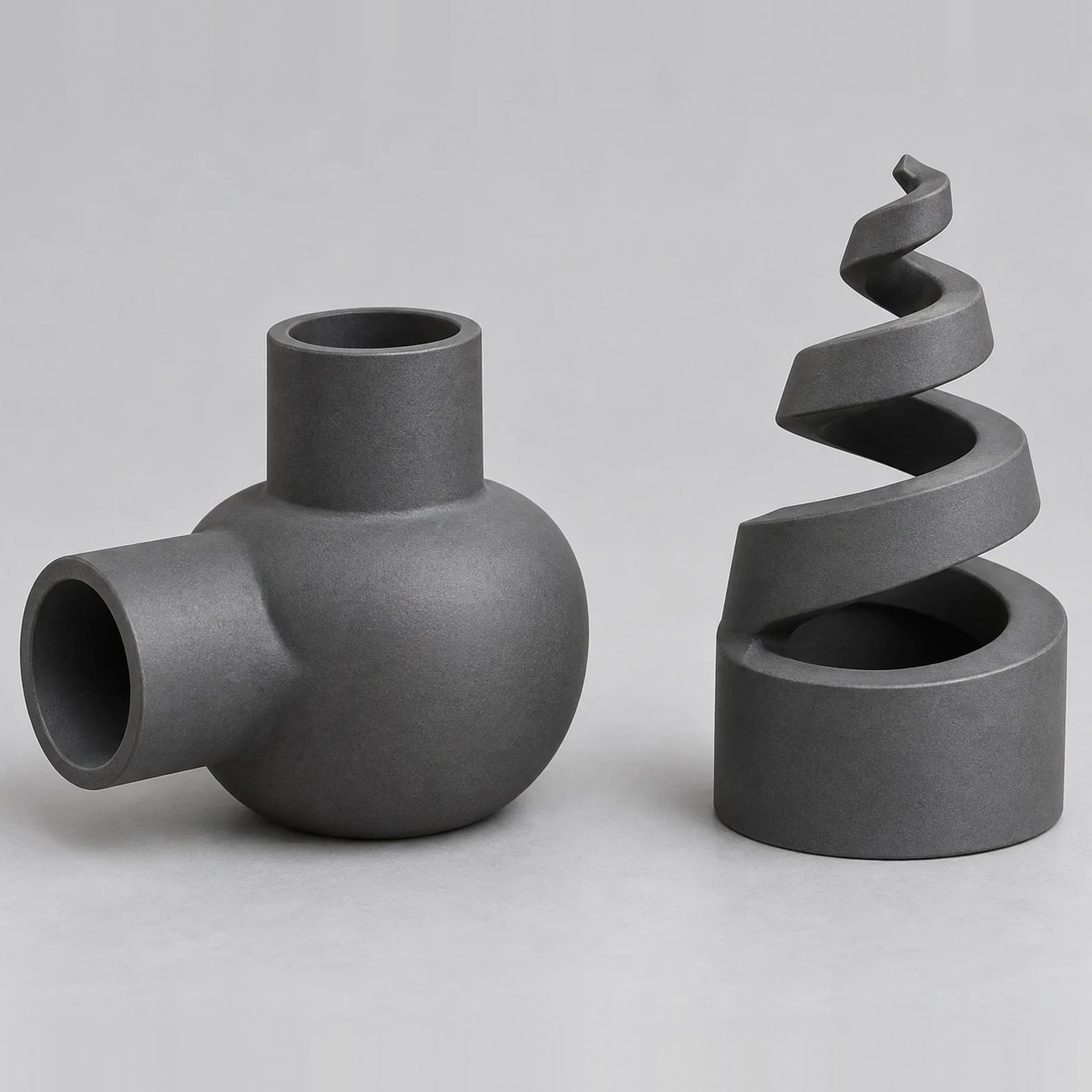
- Material
- Silicon Carbide
- Size
- Drawing-defined dimensions
- Quantity
- Specify trial and production quantities
- Applications
- Slurry spraying and abrasive blasting
Silicon carbide nozzles shape and direct abrasive or corrosive media while resisting wear at the flow passage and outlet. Typical duties include wet-FGD slurry spraying and abrasive blasting.
Browse Products
Alumina Ceramic Products
Zirconia Ceramic Products
Silicon Carbide Products
Silicon Nitride Products
Aluminum Nitride Products
Product Description
Silicon carbide nozzles shape and direct abrasive or corrosive media while resisting wear at the flow passage and outlet. Typical duties include wet-FGD slurry spraying and abrasive blasting.
A silicon carbide nozzle controls how a liquid, slurry or abrasive stream leaves the equipment. Its internal passage and outlet create the required spray distribution or concentrated jet, while the hard ceramic protects the surfaces exposed to moving particles.
In wet flue-gas desulfurization, spray nozzles distribute limestone slurry through the scrubber. In abrasive blasting, straight-bore or venturi liners guide and accelerate the air/abrasive stream. These nozzle families have different geometries and are not interchangeable.
SiC combines abrasion resistance with resistance to many process chemicals. The material route, particle passage and connection are selected together; a ceramic insert is distinguished from a complete assembly with housing, holder and seals.
Product Features
- Erosion-resistant flow passage: High hardness slows wear of the bore and outlet, helping maintain the designed discharge geometry as abrasive media passes through.
- Resistance to corrosive media: Suitable SiC grades withstand many aggressive liquids and slurries, making them useful in scrubbers and chemical-processing systems.
- More consistent flow geometry: Resistance to outlet enlargement helps retain the intended flow or spray distribution; the operating point is defined by medium and nozzle-inlet pressure.
- Duty-specific nozzle forms: Spray bodies, straight bores and venturi profiles serve different distribution or blasting requirements.
- Replaceable ceramic wear component: A ceramic body or liner can be specified separately from its holder and connections, making the wear surface and assembly scope clear.
Typical Applications
- Power-plant flue-gas desulfurization: spraying abrasive limestone slurry in wet scrubbers
- Chemical and mineral processing: distributing compatible corrosive or solids-bearing liquids
- Surface preparation and cleaning: SiC liners in straight-bore or venturi abrasive-blasting nozzles
Typical Properties & Product Data
Dense SiC Typical Properties
| Property | SSiC — sintered | SiSiC / RBSiC — reaction bonded | Condition |
|---|---|---|---|
| Density (g/cm³) | ≥3.12 | ≥3.03 | — |
| Apparent porosity (%) | <0.2 | <0.2 | — |
| Vickers hardness (HV0.5) | 2100 | 2000 | 0.5 kgf test force |
| Young’s modulus (GPa) | 400 | 350 | — |
| Fracture toughness (MPa·m¹/²) | 4–5 | 2.5–3.5 | — |
| Flexural strength (MPa) | ≥400 | ≥350 | 25°C |
| Compressive strength (MPa) | ≥2200 | ≥2000 | 25°C |
| Thermal conductivity (W/(m·K)) | ≥110 | ≥90 | 25°C |
| Mean linear thermal expansion coefficient (10⁻⁶/K) | 4.0 | 4.0 | 25–1000°C |
| Typical maximum material temperature (°C) | 1650 | 1300 | — |
Product Geometry & Configuration
| Product parameter | Configuration | Function |
|---|---|---|
| Nozzle family | Slurry/liquid spray nozzle or abrasive-blasting nozzle | Liquid distribution and abrasive acceleration require different geometries |
| Internal geometry | Spray passage, straight bore or venturi throat/outlet | Controls discharge pattern, flow and particle passage |
| Operating point | Flow at stated nozzle-inlet pressure and medium conditions | A flow value without pressure does not define nozzle performance |
| Connection | Thread, flange, holder or ceramic insert interface | Matches the pipework or blasting assembly |
| Delivery scope | Ceramic body/liner or specified complete assembly | Housing, seals and mounting parts are identified separately |
Available Forms
The illustrated swirl-chamber and spiral forms are wet-scrubbing or FGD spray-nozzle examples. Blasting liners and burner nozzles are different application branches, not interchangeable alternatives.
- FGD and slurry-spray configurations
- Duty-specific straight-bore or venturi blasting configurations
- Ceramic inserts or complete-assembly requirements
Packaging & Shipping
Packaging and transport are specified around component geometry, quantity and delivery requirements.
| Item | Details |
|---|---|
| Protection | Identify fragile edges, functional surfaces and individual separation requirements. |
| Packing scope | Confirm protective materials, carton or case arrangement and handling instructions with the order. |
| Shipping requirements | Provide destination, requested transport method and delivery requirements. |
| Payment terms | T/T / Western Union / PayPal; 50% advance payment, 50% balance before shipment |
| Shipping methods | Sea freight / Air freight / Door-to-door courier |

Related Ceramic Products
Explore distinct product requirements and material selections.

Frequently Asked Questions
Are FGD and blasting nozzles interchangeable?
No. Slurry spray duty is specified around liquid flow, particle passage and spray distribution; blasting duty involves abrasive delivery and different internal geometry. Identify the process before comparing nozzle shapes.
Why is pressure needed with a flow requirement?
A flow number without its pressure and medium conditions does not define the operating point. Give pressure at the nozzle inlet and the required flow units, rather than only the pump rating.
Can an existing part be used as the starting point?
Yes. Provide a drawing, part reference and permitted photographs, then identify connections, ceramic-only versus complete assembly scope, operating conditions and any required change.